If you’ve ever visited a prefabricated concrete plant, a bridge construction site, or a factory producing large drainage pipes, chances are you’ve seen the work of a steel cage roll welding machine. These robust, high-precision machines are the backbone of reinforced concrete manufacturing, weaving straight steel bars into rigid, cylindrical cages that give concrete its tensile strength. But here’s a question I get asked by new clients all the time: “What voltage do I need to run this thing?” Steel Cage Roll Welding Machine
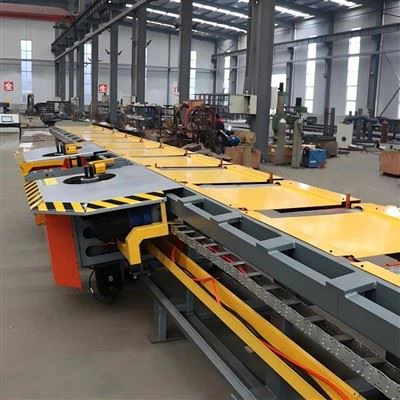
As a steel cage roll welding machine supplier with 18 years in the game, I’ve learned that choosing the wrong voltage for your equipment isn’t just a minor adjustment—it’s a costly headache. Too little voltage, and your machine will sputter, under-deliver weld quality, and even suffer premature motor failure. Too much, and you risk frying control panels, blowing fuses, or triggering dangerous electrical surges that could halt production for days. Over the years, I’ve worked with clients ranging from small concrete prefab shops in rural parts of the U.S. to large-scale infrastructure projects in Southeast Asia, and one thing holds true across the board: voltage requirements aren’t one-size-fits-all. They depend on a handful of key factors, and getting them right starts with understanding exactly how these machines use power.
Let’s break it down. Steel cage roll welding machines aren’t single-function tools—they’re integrated systems, combining high-torque motors to rotate the cage, precise weld heads that fuse cross-bars to longitudinal bars, and sophisticated control systems that time every weld to the millisecond. Each component has its own voltage needs, but the core specs that define a machine’s power requirements tie back to its size, production capacity, and design.
First, let’s talk about the standard voltages you’ll encounter, starting with North America. For small to mid-range steel cage roll welding machines—those designed to make cages with diameters from 300mm to 1500mm, used for small drainage pipes or residential foundation piers—the standard voltage is 480V three-phase. This isn’t arbitrary. Single-phase voltage (120V or 240V) simply doesn’t have enough consistent power to handle the heavy loads of a roll welding machine. Three-phase power delivers steady, balanced electricity, which is critical for the smooth rotation of the cage and the consistent heat needed for high-quality welds. Most small to mid-sized machines from reputable suppliers, including ours, are pre-wired for 480V three-phase as a standard. This works for almost all commercial and industrial electrical setups in the U.S. and Canada, and it’s the most common spec you’ll find if you’re shopping for a new machine here.
But what if you’re in Europe, Australia, or parts of Asia? The standard industrial voltage in the EU is 400V three-phase, which is technically a lower voltage than 480V, but the wattage (power) rating adjusts to compensate. A machine rated for 400V three-phase will deliver the same torque and weld power as a 480V machine of the same capacity, thanks to the way electrical power is calculated (volts times amps times power factor equals watts). That’s why it’s so important to match not just voltage, but also the power rating of your facility’s electrical system to your machine’s needs. For example, a mid-range machine with a power rating of 15kW will draw roughly the same current at 480V as a 12.5kW machine at 400V, so the amperage rating of your wiring and circuit breaker is just as key as the voltage itself.
Now, if you’re dealing with large-scale steel cage roll welding machines—those built for bridges, high-rise building cores, or large drainage culverts, with diameters upwards of 2000mm—you’ll need a much higher voltage. Most heavy-duty industrial machines of this size are rated for 600V three-phase, and some custom-built models can even go up to 690V for locations where that’s the standard industrial spec. Why the jump? Larger machines have bigger motors, heavier roll systems, and more weld heads that operate simultaneously. A 20kW motor for a 2000mm diameter cage needs more power to rotate heavy steel bars smoothly, and running that power at a higher voltage reduces the current draw, which in turn cuts down on energy loss from your wiring and reduces wear on electrical components. I once had a client in Brazil who tried to run a large 2000mm diameter machine designed for 600V on 480V, thinking it would be fine with a simple adapter. Within three months, their main rotation motor burned out, and they had to pay a $12,000 repair bill, not to mention 10 days of lost production. That’s the kind of mistake I want every client to avoid.
But voltage isn’t just about the machine’s input rating. There’s another critical factor here: your facility’s electrical supply stability. I’ve had clients come to me saying, “We have 480V three-phase in our shop, so your machine will work,” only to find out that their supply has frequent voltage drops—what electricians call “brownouts.” Even if the machine is rated for 480V, consistent voltage fluctuations can damage its sensitive control systems, which rely on a steady power supply to time welds correctly. For example, if a weld head needs 200V to create a strong, spatter-free weld, a 10% voltage drop will reduce that to 180V, leading to weak welds that can fail under the load of concrete curing. That’s why, for any machine, I always recommend adding a voltage stabilizer or uninterruptible power supply (UPS) if your facility has a history of unstable power. For large heavy-duty machines, this is non-negotiable—those weld heads can draw massive surges when they trigger, and a surge that’s too much or too little can destroy the machine’s control board in seconds.
Another common question I get: can a machine run on a different voltage if I use a transformer? The short answer is yes, but with caveats. A step-down or step-up transformer can adjust voltage to match your machine’s rating, but you have to make sure the transformer is sized correctly. For example, if your machine draws 50 amps at 480V, a transformer needs to handle at least that amperage at the new voltage. I had a small concrete prefab shop in Montana a few years ago that wanted to run a 480V machine on 240V, thinking a cheap 50 amp transformer would do the job. It burned out the transformer in two days, and we had to recommend a 100 amp transformer to handle the extra current needed at the lower voltage. The end cost was more than they expected, but it saved them from damaging the machine. Transformer solutions work, but they’re not a quick fix—they require careful calculation of your machine’s total power draw to avoid overloading the transformer.
Let’s also talk about special cases. For clients in remote locations, or those with access to only single-phase power, there are small single-phase steel cage roll welding machines available, but they’re only for the smallest jobs—cages under 1000mm diameter, used for small residential projects or small drainage pipes. These machines are rated for 240V single-phase, but they have lower power ratings, so they can’t handle heavy or high-volume production. I always advise clients to upgrade to three-phase power if they plan to scale their business, because single-phase machines will limit your production capacity and lead to higher long-term maintenance costs. For international clients, like those in parts of India, where industrial voltages are 415V three-phase, we adjust the machine’s wiring at the factory to match that spec, so you don’t have to deal with transformers or rewiring on-site. That’s a standard service we offer for clients outside North America, because we know how frustrating it is to receive equipment that doesn’t work with your local power grid.
Now, how do you confirm what voltage your machine needs? If you’re buying a new steel cage roll welding machine, the spec sheet will clearly list the required input voltage, phase, and power rating. That’s the number you should trust, not what someone tells you in a forum or a cousin who works with welding equipment. If you’re replacing an old machine, check the label on the motor or control panel of your current machine—that will have the original voltage rating, which is the best starting point. If you’re not sure, reach out to a licensed electrician to test your facility’s power supply, including voltage stability and amperage capacity, before you order your machine. This small step can save you thousands in setup costs and downtime.
Let me share a recent example to drive this home. A client of ours in Vietnam reached out last year, saying he had a local machine for small cages, but he was expanding to make large cages for highway projects, so he needed a new roll welding machine. He told me his facility had 380V three-phase power, which is standard in Vietnam. I sent him our standard mid-range machine spec sheet, which is rated for 400V three-phase, and we confirmed that a small transformer would easily adjust between 380V and 400V, with no impact on performance. He ordered the machine, had our on-site technician help with setup, and within a week he was producing high-quality cages for his highway project. The key here was that he did his homework, matched his local power to the machine’s spec, and didn’t try to cut corners.
I’ve seen too many clients make the mistake of focusing only on the upfront cost of a machine, and ignoring the cost of electrical setup. A $50,000 machine is a big investment, so spending a few hundred dollars on an electrician to test your power, or a stabilizer to ensure consistent voltage, is worth every penny. It’s better to plan for the right voltage upfront than to deal with a machine that underperforms or breaks down after a few months.
If you’re still shopping around for a steel cage roll welding machine, pay close attention to the voltage specs listed by different suppliers. Some will advertise a “universal” voltage machine, but that usually means it’s designed with a built-in voltage converter, which can add to the cost and slightly reduce power efficiency. Others will offer custom voltage setups, which is ideal for international clients or those with non-standard power supplies. At our company, we don’t cut corners on power system design—we build machines that are matched to the most common industrial voltages, and we offer free consultation to help you figure out exactly what you need for your facility.
At the end of the day, the voltage requirement of a steel cage roll welding machine isn’t just a technical detail—it’s the foundation of your production efficiency and the lifespan of your equipment. Get it right, and you’ll have a machine that runs smoothly, delivers consistent weld quality, and lets you take on more jobs to grow your business. Get it wrong, and you’re looking at costly repairs, downtime, and missed deadlines.

If you’re ready to invest in a steel cage roll welding machine, or you have questions about matching voltage to your facility’s power supply, feel free to reach out to discuss your specific needs. We’ve worked with hundreds of clients across the globe, and we can help you find the right machine and power setup to fit your operations.
CNC Straightening and Cutting Machine References:
- Industrial Electrician Association. (2021). Voltage Requirements for Industrial Welding Equipment. Industrial Electrical Standards Publication.
- Concrete Prefabrication Machinery Association. (2022). Power and Specification Guidelines for Steel Cage Roll Welding Machines. Construction Equipment Journal.
- National Electrical Manufacturers Association (NEMA). (2020). Three-Phase Power Ratings for Heavy Industrial Machinery. NEMA Standards Publication.
- International Code Council (ICC). (2021). Electrical Setup Guidelines for Construction and Prefabrication Equipment. ICC Building Code Supplement.
Xuhui (Shandong) Intelligent Equipment Co., Ltd.
Xuhui (Shandong) Intelligent Equipment Co., Ltd. is one of the most professional steel cage roll welding machine manufacturers and suppliers in China. Please feel free to wholesale high quality machines made in China here and get quotation from our factory. Contact us for customized service.
Address: Industrial Park, Hetaoyuan Town, Juye County, Heze City, Shandong Province, China.
E-mail: yue@xuhuijx.com
WebSite: https://www.xuhuiintelligent.com/
